AI Customer Service System
PT Tekstil Lintas Indonesia
AI Engineer & System Analyst (Contract)
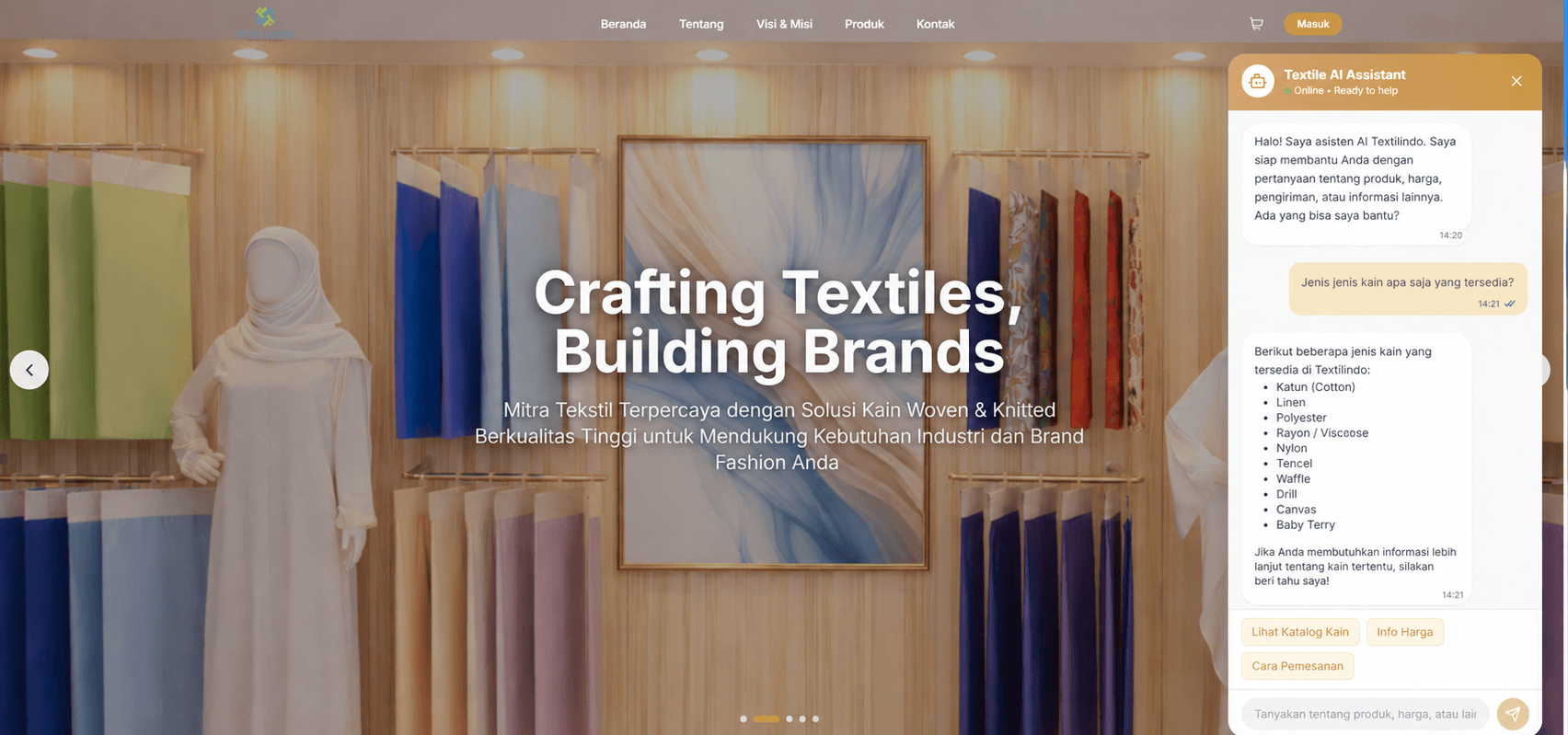
Overview
Designed and delivered a full AI-powered customer service pipeline for a textile manufacturer, replacing manual inquiry handling with a system capable of answering questions about products, availability, pricing, and company policy, with every response grounded in live business data.
Fine-tuned Meta-Llama-3-8B-Instruct with 4-bit QLoRA to adapt the model exclusively to communication style and customer service tone. Business facts such as product specs, pricing, and stock levels were deliberately kept out of model weights and handled at inference time through retrieval and live data lookups, preventing the model from hallucinating information it was never trained on.
Architected a dual-knowledge-base RAG pipeline with two distinct corpora: one for operational and company information (addresses, policies, operating hours, shipping terms), and one for static product catalog data (fabric types, material characteristics, standard specifications). Both are indexed with TF-IDF vectorization and retrieved via cosine similarity at inference time, with top-k results injected directly into the generation context.
Built an n8n-based automation layer as a read-only ERP proxy. Incoming requests are validated, routed by action type, and forwarded to the live ERP system. Product search supports both exact-match and fuzzy fallback to maximize recall, while a dedicated response sanitizer strips all internal fields (supplier references, cost margins, internal IDs) before the data reaches the language model, ensuring it only ever sees customer-safe, normalized product information.
Implemented a three-phase conversation state machine (Discovery, Awaiting Color Selection, and Detail) enabling coherent multi-turn product inquiry flows. Semantic intent parsing is performed in a single LLM call that simultaneously extracts intent category, product reference, and color preference, avoiding the latency cost of a separate classification model. The orchestration layer decides whether to invoke the RAG retriever, the ERP proxy, or both, based on intent and current conversation phase.
Architecture & Workflow
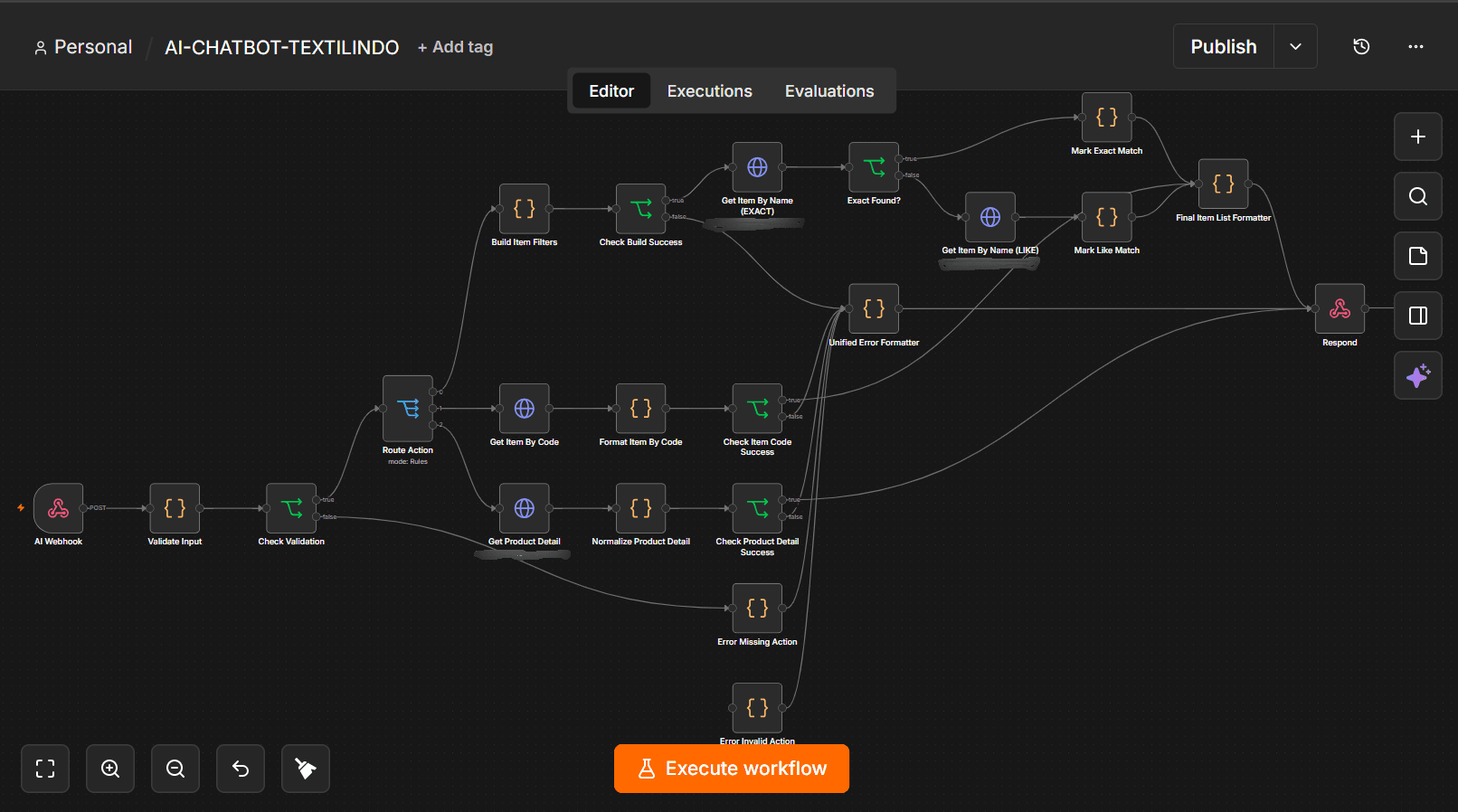
Automation workflow acting as a read-only ERP proxy, handling input validation, action routing, exact-to-fuzzy product search fallback, response normalization, and unified error formatting before data reaches the language model.
What Was Built
- Fine-tuned Meta-Llama-3-8B-Instruct with 4-bit QLoRA for style and tone adaptation only; no business facts were baked into the model weights
- Built dual-corpus RAG pipeline: one knowledge base for operational facts, one for static product catalog, both indexed with TF-IDF and retrieved via cosine similarity
- Designed n8n automation layer as a read-only ERP proxy with structured action routing and input validation
- Implemented exact-match → fuzzy fallback search strategy to maximize product retrieval recall without false positives
- Built a data sanitizer stage that strips internal fields from ERP responses before they reach the language model, eliminating the risk of accidental data exposure
- Normalized multi-variant product responses (color codes, stock quantities, pricing tiers) into a flat structure consumable by the generation prompt
- Designed a three-phase conversation state machine (Discovery → Color Selection → Detail) for coherent multi-turn product inquiry flows
- Semantic intent parsing in a single LLM call: extracts intent, product reference, and color preference simultaneously
- Anti-hallucination guarantee: live data fields (price, stock) are always sourced from the ERP layer; the model is instructed to decline rather than fabricate
- Led end-to-end stakeholder requirements gathering, system design, validation, and delivery as sole AI engineer